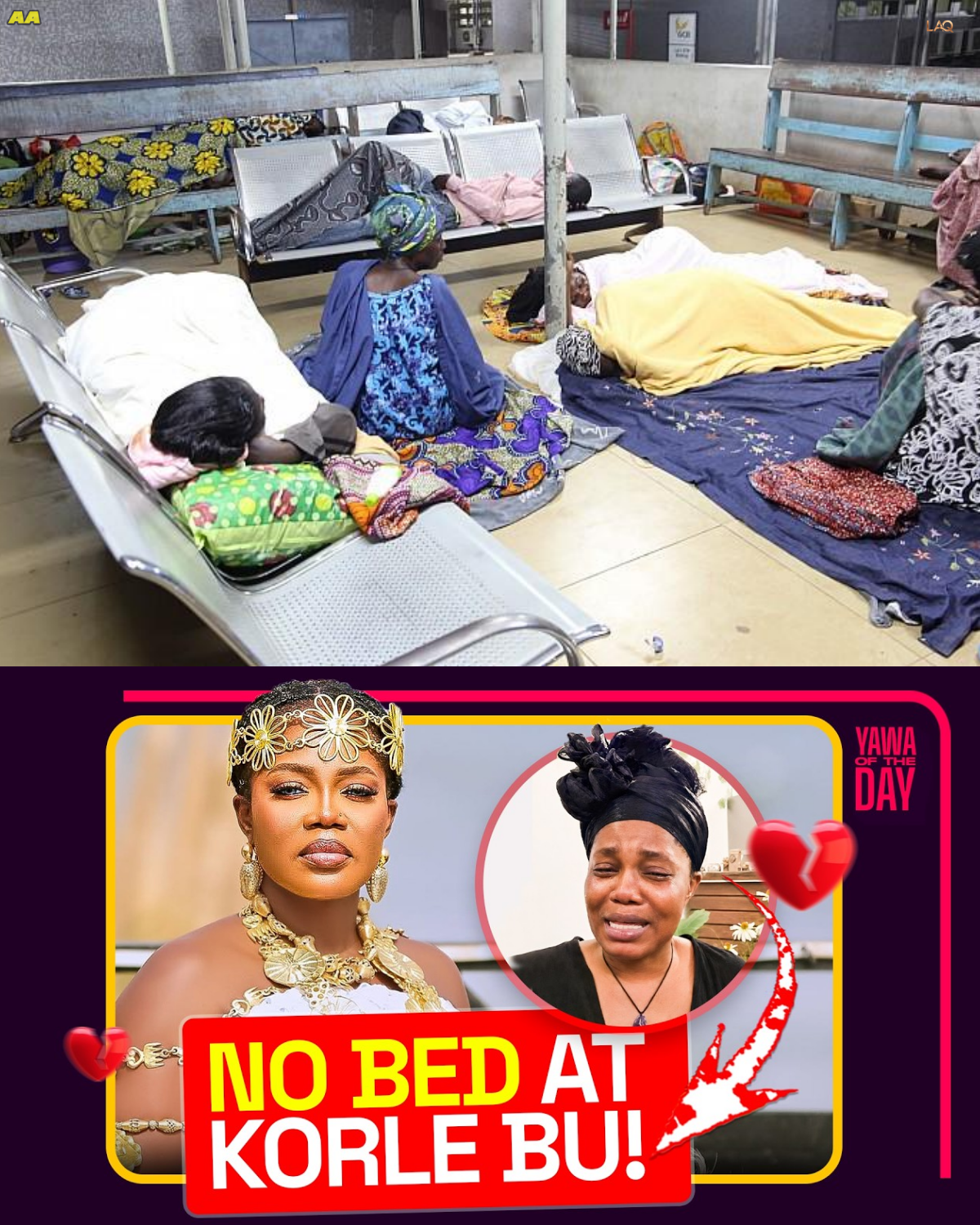
When Fame Cannot Save You: Ghana’s Healthcare Crisis Exposed Through a Celebrity’s Tragedy

The death of a prominent Ghanaian musician’s sister has become a catalyst for urgent national conversation about a systemic healthcare failure that has plagued the country for decades: the chronic shortage of hospital beds in public medical facilities. The incident, which left the celebrated artist Mzbel devastated and tearful as she recounted her loss on social media, has transformed a personal tragedy into a public indictment of government priorities, healthcare management, and the inequality that determines who lives and who dies in Ghana’s medical system.
The events that led to this moment unfolded with tragic swiftness. Mzbel’s sister experienced a medical emergency that required immediate hospitalization. Her family rushed her to Korle-Bu Teaching Hospital, one of Ghana’s largest and most prestigious public medical institutions located in the capital city of Accra. The hospital, which should have represented hope and the possibility of life-saving treatment, instead delivered devastating news: there were no available beds. Despite the severity of the patient’s condition and the urgency of her medical needs, the hospital could not accommodate her. Within hours of being turned away, Mzbel’s sister died without receiving the diagnosis or treatment that might have saved her life.
The tragedy became public when Mzbel, visibly distraught and weeping, shared her experience on a Facebook livestream. Her emotional account resonated deeply with viewers not only because of her celebrity status but because her story illustrated a harsh reality that countless ordinary Ghanaians face regularly. If a well-known public figure with resources and connections could not secure a hospital bed for her dying sister, what hope exists for the average citizen with limited means and no influential contacts?

This incident prompted intense discussion on the Kwadwo Sheldon Studios program, where hosts and participants examined not just the immediate tragedy but the broader systemic failures that made it possible. The discussion revealed layers of dysfunction, mismanagement, and political negligence that have persisted across multiple administrations and decades of governance.
The hosts emphasized that Ghana’s healthcare infrastructure has remained essentially stagnant despite massive changes in other areas of society. Over many decades, the country has cycled through numerous governments representing different political parties, yet the fundamental problem of insufficient hospital beds has never been adequately addressed. The population has grown to approximately 35 million people, yet the total number of hospital beds meeting national standards across the entire country remains shockingly low, estimated at fewer than 5,000 beds. This disparity means that Ghana’s healthcare system is catastrophically undersized relative to the population it serves.
The consequences of this shortage manifest in degrading conditions throughout the public healthcare system. Pregnant women in labor have reportedly been forced to give birth on makeshift mats and temporary bedding because no proper hospital beds were available. Patients with serious illnesses wait in corridors and overcrowded wards, receiving minimal care in conditions that would be considered unacceptable in most developed nations. The “no bed” response has become so common that it has acquired its own terminology, reflecting how normalized this failure has become.

What particularly infuriated the program participants was the apparent disconnect between government spending priorities and healthcare needs. Ghana’s government has allocated substantial resources to other projects while allowing the healthcare system to deteriorate. The national football team, known as the Black Stars, received approximately 30 million USD in government funding, yet these investments have not consistently translated into improved performance or infrastructure. Similarly, the government committed 145 million USD to construct a sports complex, yet even these facilities have fallen into disrepair due to poor maintenance and management. Meanwhile, the basic infrastructure of the healthcare system—beds, equipment, supplies—remains chronically underfunded.
The participants articulated a fundamental frustration: the government clearly possesses the capacity to identify priorities, allocate resources, and execute projects. The question is why healthcare, which literally determines whether citizens live or die, has not been treated with corresponding urgency and investment. The disparity between what the government spends on sports infrastructure and what it spends on hospital beds suggests a troubling misalignment of values and priorities.
One particularly contentious aspect of the discussion involved the question of responsibility. Erica suggested that part of the problem stemmed from the Ghanaian population itself, arguing that widespread littering, poor sanitation practices, and lack of civic consciousness contributed to the deterioration of public systems. She implied that citizens bore some responsibility for the dysfunction they experienced.

Scanty strongly rejected this analysis, arguing that the failure was fundamentally a leadership problem rather than a citizen problem. He pointed out that Ghanaians who live abroad, whether in London, the United States, or other countries, consistently demonstrate respect for laws and public systems. They do not litter excessively, they obey traffic regulations, and they maintain public spaces responsibly. This behavior change, Scanty argued, occurs not because Ghanaians are inherently more disciplined abroad but because they face consistent enforcement of rules and meaningful consequences for violations. When traffic lights are enforced with substantial fines, people stop running red lights. When littering results in significant penalties, people stop discarding trash indiscriminately.
Scanty’s argument suggested that the problem was not the character or consciousness of the Ghanaian people but rather the failure of leadership to establish and enforce standards. He emphasized that the Minister of Health possesses complete data regarding the number of available hospital beds, the staffing levels, and the equipment status of public hospitals. This information is not hidden or difficult to obtain. Therefore, the minister cannot claim ignorance about the crisis. The fact that meaningful action only occurs when a celebrity publicly weeps about losing a family member demonstrates that the system responds to media pressure rather than to the systematic needs of the population.
The discussion also touched on the political dimension of healthcare failures. The participants noted that citizens and political supporters often remain silent when their preferred political party holds power, even as healthcare deteriorates. They only become vocal when the opposing party is in government. This pattern of selective outrage based on political affiliation rather than consistent concern for public welfare has allowed successive governments to neglect healthcare without facing sustained political consequences. The hosts called for healthcare to be treated as a national issue that transcends partisan politics, with citizens and leaders united in demanding that adequate resources be allocated regardless of which party holds power.

The practical advice offered by the program participants was sobering and reflected the grim reality of healthcare in Ghana. They essentially counseled that if one has financial means, the rational response is to avoid public hospitals entirely and instead seek treatment at private medical facilities with established reputations. While this advice protects those with resources, it simultaneously highlights the cruel inequality built into the system. Those with money can access adequate care; those without must gamble with their lives in a public system that may turn them away with the simple statement that no beds are available.
This stratification of healthcare access based on wealth represents a fundamental failure of the public health system. In theory, public hospitals exist to serve the entire population, with particular responsibility to those who cannot afford private alternatives. When public hospitals become so dysfunctional that they cannot reliably provide basic services, the entire social contract is violated. The wealthy can protect themselves through private alternatives, but the poor and middle class are left vulnerable to a system that has failed them.
Mzbel’s tragedy illustrates how this failure affects not just anonymous statistics but real people with names, families, and futures. Her sister was not a stranger but a beloved family member. The loss was not abstract but deeply personal and painful. Yet the system that failed her sister fails countless other families every day, most of whom lack the platform or resources to make their tragedy public. Mzbel’s willingness to share her grief publicly has transformed a private loss into a potential catalyst for national conversation and, hopefully, policy change.

The incident raises uncomfortable questions about governance, priorities, and the value placed on human life. It demonstrates that infrastructure problems are not inevitable consequences of poverty or underdevelopment but rather reflect choices made by leaders about how to allocate resources. Ghana has the capacity to build adequate healthcare infrastructure; the question is whether it has the political will to do so. Until that will emerges, Ghanaians with means will continue to seek private alternatives, while those without will continue to face the heartbreaking possibility of being turned away from hospitals with the words that haunted Mzbel: “No bed available.”
Disclaimer : This content may be created by AI for entertainment purposes. Any resemblance to real persons, events, or places is coincidental.
