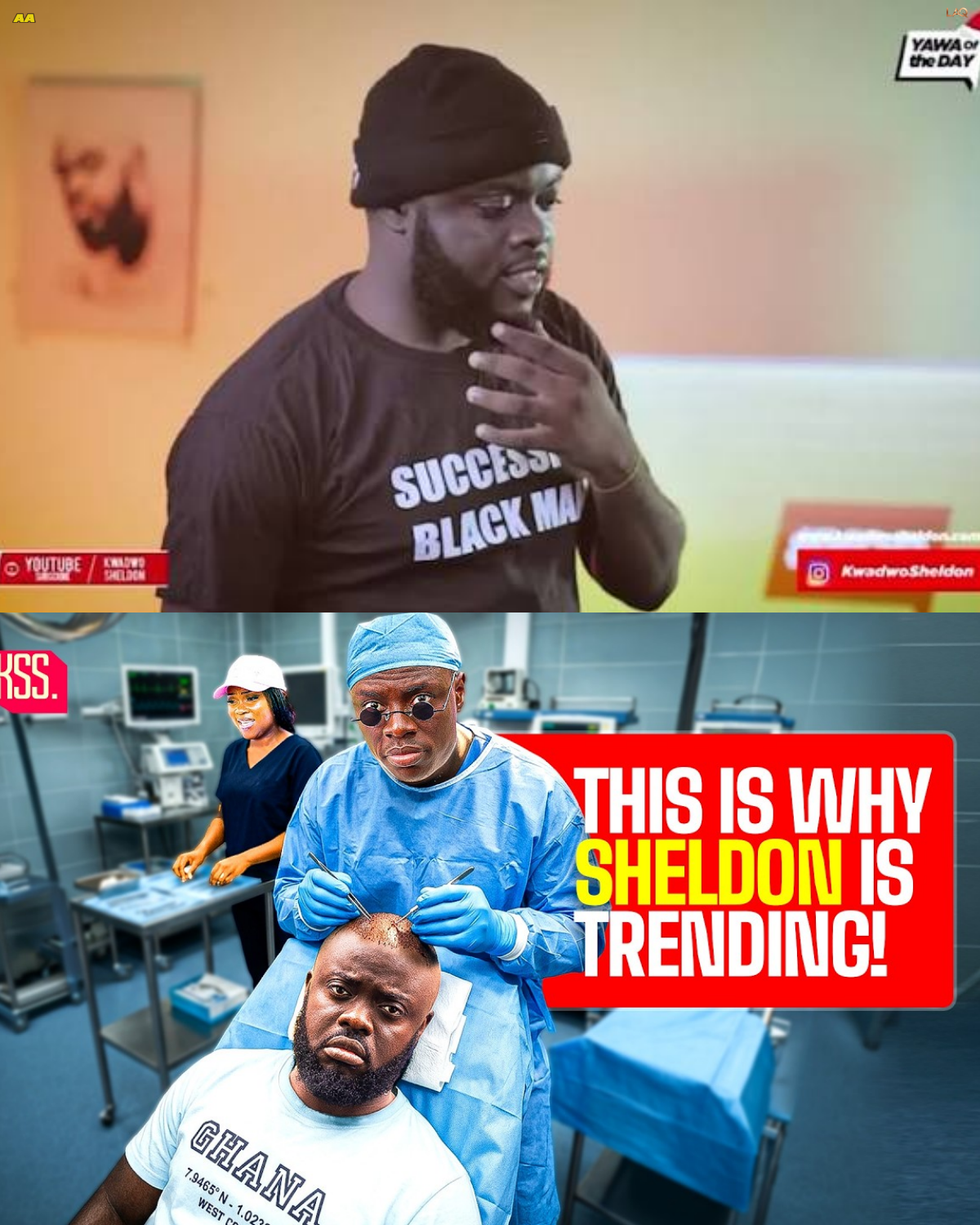
The Baldness Chronicles: Why Ghana’s Kwadwo Sheldon’s Hair Transplant Quest Became the Internet’s Latest Comedy Gold

In the ever-evolving landscape of social media entertainment, few stories capture the internet’s attention quite like a celebrity’s personal struggle turned public spectacle. Ghana’s content creator Kwadwo Sheldon recently found himself at the center of a viral moment that perfectly encapsulates the modern age of oversharing, self-deprecation, and the sometimes hilarious consequences of chasing perfection. What started as a private medical consultation somehow transformed into a full-blown comedy roast, courtesy of his own employee Scanty, whose detailed breakdown of Sheldon’s hair transplant journey has left audiences across multiple platforms in stitches.
The story begins innocuously enough with Sheldon posting images on social media platforms like Threads and X, hinting at his intentions to undergo a hair transplant procedure. For most public figures, such a revelation might warrant a sympathetic response or perhaps a few supportive comments from fans. However, in Sheldon’s case, the situation took on an entirely different dimension because of one crucial detail: he had built a significant portion of his comedic brand around his baldness. For years, Sheldon had been the man who confidently proclaimed that male baldness was natural, that it was nothing to be ashamed of, and that a man’s worth had absolutely nothing to do with the presence or absence of hair on his scalp. He had weaponized his own hair loss as comedic material, turning what could have been a source of insecurity into a platform for entertainment and social commentary.
This context is essential to understanding why the internet found Sheldon’s sudden pivot toward hair restoration so deliciously ironic. Here was a man who had spent considerable time and energy convincing others, and presumably himself, that baldness was acceptable, even desirable in its own way. Yet the moment he had the financial means to address the issue, he quietly began reaching out to hair transplant clinics in Turkey, a country renowned for its advanced cosmetic surgery procedures and competitive pricing. The contradiction was too perfect, too laden with comedic potential for anyone to ignore, and Scanty, his employee and apparent confidant, decided to capitalize on this golden opportunity.
What makes Scanty’s account particularly entertaining is not merely the fact that he exposed his boss’s hypocrisy, but rather the specific details he revealed about the medical consultations Sheldon had received. According to Scanty’s recounting of the story, Turkish hair transplant specialists who reviewed Sheldon’s photographs were reportedly stunned by the extent of his baldness. The doctors estimated that Sheldon would require approximately 600,000 hair grafts to adequately cover his scalp. To put this number into perspective, Scanty explained that a standard hairline transplant for an average person typically requires only around 1,000 grafts and can be completed in a single day-long procedure running from early morning to late afternoon. The sheer magnitude of Sheldon’s requirements meant that his procedure would need to be divided into multiple sessions, potentially spanning weeks or even months of intensive surgical work.
Scanty’s descriptions of Sheldon’s scalp became increasingly colorful and creative as he elaborated on the medical consultations. He compared the expanse of baldness to the N1 highway, one of Ghana’s major thoroughfares, suggesting that the barren landscape of Sheldon’s head was vast enough to warrant its own infrastructure designation. In another particularly memorable comparison, Scanty likened the scalp to a dried coconut, emphasizing the texture and the complete absence of vegetation. The comedy intensified when Scanty joked that the medical team would need to divide Sheldon’s head into multiple zones, each requiring its own team of surgeons working in shifts around the clock for approximately two weeks just to make a meaningful dent in the restoration project.
Beyond the immediate comedic value, Scanty’s revelations also touched on deeper aspects of Sheldon’s personal history. According to the account, Sheldon’s hair loss journey began remarkably early in his life, starting at the age of fifteen. By the time he reached thirty-one years old, he had been dealing with progressive baldness for nearly two decades. This extended timeline adds another layer to the narrative because it suggests that Sheldon’s philosophical acceptance of baldness was not merely a matter of making the best of a recent development, but rather a long-term coping mechanism developed over the course of his formative years and early adulthood.
Scanty also provided an interesting psychological angle to the story by suggesting that Sheldon’s sudden desire to pursue hair restoration was at least partially motivated by peer pressure. Specifically, Scanty himself had undergone a successful hair transplant procedure at a clinic in Accra, Ghana’s capital city, and had achieved impressive results. Seeing his employee’s transformation apparently sparked something in Sheldon, creating a sense of competitive comparison that ultimately led him to seek out his own solution. This detail humanizes the narrative considerably, as it demonstrates that even successful content creators and public figures are not immune to the social pressures and insecurities that affect ordinary people.
However, Scanty was not content to simply expose his boss’s hypocrisy and leave it at that. Instead, he took on the role of concerned advisor, offering what he framed as practical counsel to Sheldon regarding the viability of his hair restoration dreams. Scanty’s fundamental argument was that after twenty years of progressive hair loss, the damage was simply too extensive to be meaningfully reversed in a reasonable timeframe. He pointed out that the recovery process following hair transplant surgery requires strict adherence to post-operative protocols, including avoiding sweating, refraining from running or jogging, and staying out of water for extended periods. For someone like Sheldon, who presumably maintains an active lifestyle as a content creator, these restrictions could prove to be genuinely burdensome.
Scanty’s most memorable piece of advice came in the form of a somewhat philosophical declaration: when baldness has become so deeply ingrained, so fundamentally woven into the fabric of a person’s existence, perhaps it is time to accept it rather than fight it. He suggested that Sheldon should simply give up on the notion of hair restoration and embrace his natural state. The phrasing was deliberately provocative and humorous, but it also contained a kernel of genuine wisdom about the limits of medical intervention and the importance of self-acceptance.

What is particularly interesting about this entire saga is how it reflects broader cultural conversations happening across social media platforms. The story touches on themes of authenticity, the gap between public personas and private desires, the commodification of the human body, and the ever-present pressure to conform to conventional standards of attractiveness. Sheldon had built a career partly on the premise that he was comfortable with his appearance, that he had transcended the shallow concerns about physical appearance that plague so many people. Yet his actions suggested something more complicated: that comfort with one’s appearance and the desire to change it are not mutually exclusive concepts.
The viral nature of Scanty’s account also speaks to the current state of entertainment and social media consumption. In an era where traditional comedy is increasingly supplemented by real-life drama and personal revelations, the line between public and private has become remarkably blurred. What might have once remained a confidential matter between an employer and employee, or between a patient and a medical professional, now becomes fodder for public entertainment and discussion. This democratization of comedy and commentary has created new opportunities for creators to build audiences and generate engagement, but it also raises questions about privacy, consent, and the ethics of using someone else’s personal struggles for entertainment purposes.
From Sheldon’s perspective, the entire situation represents a complex mixture of outcomes. On one hand, he has become the subject of widespread mockery and has had his personal medical decisions exposed to public scrutiny. On the other hand, the viral nature of the story has likely generated significant attention and engagement for both himself and Scanty, potentially translating into increased viewership and revenue opportunities. In the attention economy that governs social media, even negative attention can be monetized and converted into tangible benefits.
The story also highlights the particular challenges faced by content creators who build their brands around specific characteristics or traits. Once an audience becomes accustomed to seeing a creator in a particular way, any significant change can feel like a betrayal or a fundamental shift in the creator’s identity. Sheldon’s potential hair restoration would represent a dramatic visual transformation that could confuse or alienate some of his existing audience members who have come to know and appreciate him specifically because of his baldness.
Looking at this situation from a broader perspective, the Kwadwo Sheldon hair transplant saga serves as a modern parable about authenticity, acceptance, and the sometimes absurd lengths to which people will go in pursuit of conventional beauty standards. It is a story that manages to be simultaneously hilarious and poignant, entertaining and thought-provoking. Whether Sheldon ultimately proceeds with his hair restoration plans or decides to heed Scanty’s advice and embrace his natural state remains to be seen. What is certain, however, is that his journey has already provided the internet with considerable entertainment value and has sparked important conversations about self-image, social pressure, and the nature of authenticity in the age of social media.
Disclaimer : This content may be created by AI for entertainment purposes. Any resemblance to real persons, events, or places is coincidental.
